
Modern conversations about mental health often focus on therapy, medication, mindfulness, diet, or exercise. All of these play important roles. But there is one factor that quietly sits beneath almost every aspect of emotional and cognitive health—and it is often the first thing sacrificed when life gets busy.
Sleep.
For many people, sleep is treated as optional maintenance. Something that can be shortened during stressful weeks, traded for productivity, or replaced with caffeine the next day. Yet research over the past two decades has made something increasingly clear: sleep is not simply rest. It is one of the most active biological processes the brain performs each day.
While you sleep, your brain regulates mood, consolidates memory, clears metabolic waste, stabilizes hormones, and resets the nervous system. When sleep quality declines, many of these systems begin to struggle.
This raises an interesting question: could sleep be one of the most overlooked pieces of the mental health puzzle?
Increasingly, scientists and clinicians believe the answer may be yes.
Why Sleep and Mental Health Are So Closely Connected
Sleep and mental health influence each other in both directions. Poor sleep can increase the risk of anxiety, depression, irritability, and cognitive fog. At the same time, mental health challenges can make restful sleep harder to achieve.
This feedback loop means that improving sleep can sometimes improve mood, resilience, and clarity faster than people expect.
During healthy sleep cycles, several important neurological processes occur.
The brain shifts between stages of deep sleep and REM sleep. Deep sleep allows physical restoration and immune regulation. REM sleep plays a major role in emotional processing and memory consolidation.
During REM sleep, the brain essentially replays experiences from the day while lowering levels of stress hormones such as norepinephrine. Researchers believe this process helps reduce the emotional intensity attached to memories.
In simple terms, sleep allows the brain to process life.
When REM sleep is shortened or disrupted, emotional experiences may not be fully processed, which can leave the brain more reactive the next day.
This is why people who sleep poorly often report feeling more emotionally sensitive, anxious, or overwhelmed.
Sleep also supports the brain’s glymphatic system, a recently discovered network that clears metabolic waste from brain tissue during deep sleep. One of the substances removed during this process is beta-amyloid, a protein associated with neurodegenerative diseases.
The brain quite literally performs a nightly cleanup process while we sleep.
Without adequate sleep, this process becomes less efficient.

What Happens to the Brain When Sleep Is Inadequate
Most people have experienced the short-term effects of poor sleep.
The day after a restless night, concentration becomes more difficult. Small frustrations feel larger. Memory slips are more common. Energy is inconsistent.
But when sleep deprivation becomes chronic, the effects become more serious.
Research shows that insufficient sleep can disrupt several systems that regulate emotional stability.
The amygdala, a region of the brain involved in emotional responses, becomes more reactive. At the same time, the prefrontal cortex—the area responsible for decision making and emotional regulation—becomes less effective.
This combination can create a brain that reacts strongly but regulates poorly.
Studies using brain imaging have found that individuals who are sleep deprived can experience up to a 60 percent increase in amygdala reactivity to negative stimuli.
In practical terms, this means situations that might normally feel manageable can suddenly feel overwhelming.
Sleep loss also influences neurotransmitters and hormones linked to mood, including serotonin, dopamine, and cortisol. When sleep becomes inconsistent, these chemical signals can shift out of balance.
Over time, this can increase vulnerability to mood disorders.
It is not surprising that insomnia is one of the most common symptoms reported by people experiencing depression or anxiety.
But interestingly, research now suggests that improving sleep quality can sometimes reduce symptoms of both.
Sleep and Emotional Resilience
Emotional resilience is the ability to adapt to stress, recover from setbacks, and maintain perspective during challenging moments.
Sleep plays a critical role in maintaining this resilience.
During deep sleep, the brain regulates the stress response system. Cortisol levels gradually decline through the night and begin to rise again toward morning, preparing the body for wakefulness.
When sleep is disrupted, this rhythm can become irregular.
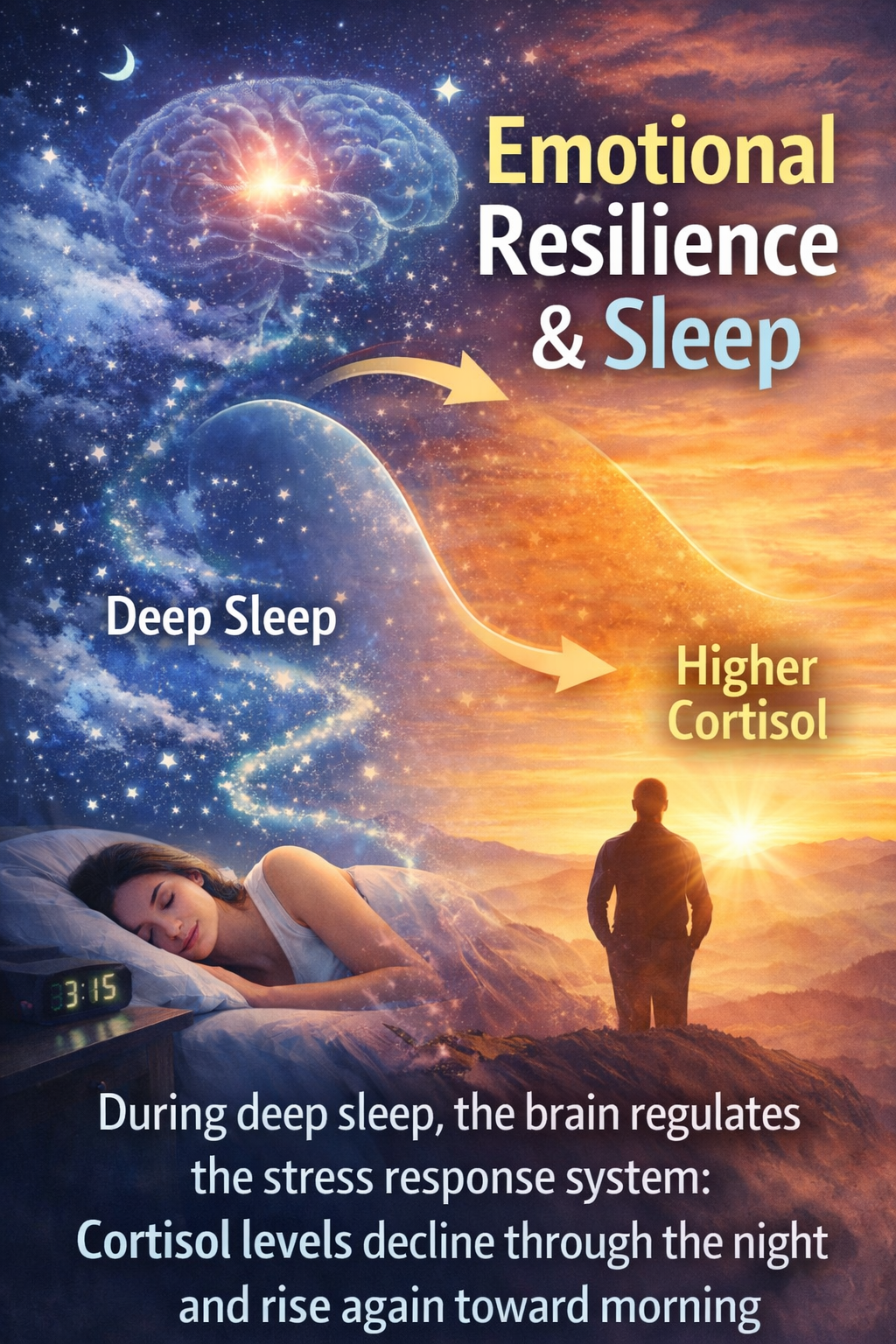
Elevated nighttime cortisol levels have been linked to anxiety, insomnia, and difficulty relaxing.
Sleep also supports emotional memory processing. During REM sleep, the brain revisits emotional experiences in a neurochemical environment that is less reactive than when we are awake.
This allows the brain to file experiences away without attaching the same intensity of stress.
Without this processing period, emotional experiences can accumulate.
Over time, this can create a sense of mental overload.
The Importance of Sleep Across Different Stages of Life
Sleep needs change across the lifespan. Understanding how sleep supports mental health at different ages helps explain why consistent sleep habits are so important.
Children (6–12 years)
During childhood, sleep supports rapid brain development, emotional regulation, and learning.
School-aged children typically require 9 to 12 hours of sleep each night. During this period, the brain forms neural connections that support memory, problem solving, and emotional control.
Insufficient sleep in children has been associated with increased behavioral issues, attention challenges, and mood instability.
Children who sleep well tend to demonstrate better focus, improved academic performance, and stronger emotional regulation.
Teenagers (13–18 years)
Adolescence is a time of major neurological change.
Teenagers experience a natural shift in circadian rhythm that makes them feel more alert later in the evening. Unfortunately, early school schedules often conflict with this biological pattern.
Most teenagers require about 8 to 10 hours of sleep per night, yet many receive far less.
Sleep deprivation during adolescence has been linked to increased rates of anxiety, depression, and risk-taking behavior.
Researchers believe this occurs because the prefrontal cortex—the brain’s decision-making center—is still developing during these years.
Sleep supports the maturation of this region, which helps teenagers develop emotional regulation and impulse control.
Adults (18–64 years)
Most adults require between 7 and 9 hours of sleep each night.
During adulthood, sleep plays a major role in cognitive performance, emotional resilience, and metabolic balance.
However, modern lifestyles often challenge sleep quality. Artificial light exposure, irregular work schedules, digital device use, and stress can all interfere with natural sleep rhythms.
Adults who consistently sleep less than six hours per night show increased risk for mood disorders, cardiovascular issues, and cognitive decline.
Sleep also influences productivity and creativity. Studies have shown that well-rested individuals demonstrate improved problem-solving abilities and greater cognitive flexibility.
Older Adults (65+ years)
Sleep patterns often shift later in life. Older adults may fall asleep earlier, wake earlier, and experience lighter sleep.
While total sleep needs remain similar—around 7 to 8 hours—deep sleep stages may become shorter.
Because of this, maintaining healthy sleep routines becomes even more important.
Sleep supports memory consolidation and neurological protection in older adults. Poor sleep has been associated with increased risk of cognitive decline and dementia.
Maintaining consistent sleep patterns may help support long-term brain health.
Why Modern Life Disrupts Sleep
Despite its importance, sleep has become increasingly difficult for many people.
Several aspects of modern life interfere with natural sleep rhythms.
Artificial lighting can delay melatonin production, the hormone that signals the body to prepare for sleep. Exposure to screens late at night may further suppress this signal.
Stress and constant connectivity also play a role. When the brain remains in a heightened state of alertness, it becomes harder to transition into restful sleep.
Irregular schedules—such as shift work or frequent travel—can disrupt circadian rhythms.
Diet and lifestyle habits matter as well. Late-night meals, caffeine intake, and lack of physical activity can all influence sleep quality.
The result is a population that is often chronically sleep-deprived.
Nutritional Factors That May Support Healthy Sleep
Sleep is influenced by several nutrients that help regulate neurotransmitters and circadian rhythms.
Certain minerals and amino acids play roles in relaxation, nervous system balance, and hormone production.
Magnesium is often associated with sleep support because it helps regulate GABA, a neurotransmitter involved in calming brain activity.
Zinc plays a role in neurotransmitter signaling and immune function, both of which influence sleep quality.
Copper participates in enzymes that support neurological function and neurotransmitter balance.
Potassium contributes to nerve signaling and muscle relaxation, which may influence nighttime comfort and sleep continuity.
Phosphorus is involved in cellular energy production and ATP metabolism, which supports overall metabolic balance and neurological health.
Amino acids can also influence sleep cycles.
Tryptophan serves as a precursor to serotonin and melatonin, both of which help regulate sleep timing.
Glycine has been studied for its potential role in improving sleep quality by helping lower core body temperature and promote relaxation.
While these nutrients are not sleep medications, adequate intake supports many biological processes that influence sleep regulation.

Practical Habits That Support Better Sleep
Improving sleep does not always require dramatic changes.
Often, small adjustments to daily habits can make meaningful differences.
Consistent sleep timing helps regulate circadian rhythms. Going to bed and waking up at similar times each day allows the brain to establish predictable sleep patterns.
Light exposure matters as well. Morning sunlight helps signal the brain to maintain healthy circadian timing.
Limiting screen exposure in the evening can also help the brain transition toward sleep.
Physical activity during the day supports deeper sleep cycles, while relaxation practices in the evening may help the nervous system shift into a calmer state.
Nutrition also plays a role. Balanced meals that support stable blood sugar levels may help reduce nighttime awakenings.
These changes do not always produce instant results, but over time they can strengthen the body’s natural sleep systems.
Sleep as a Foundational Reset
When people think about improving mental health, they often look for complex solutions.
But sometimes the most powerful changes begin with the simplest habits.
Sleep is one of the few activities that simultaneously influences brain function, emotional resilience, immune health, and metabolic balance.
It is the brain’s nightly reset.
When sleep improves, people often notice better mood stability, clearer thinking, improved focus, and greater stress tolerance.
These improvements can ripple outward into nearly every area of life.
While sleep alone is not the entire answer to mental health challenges, it is increasingly recognized as one of the most foundational pieces.
In a world that often encourages people to push harder and rest less, reclaiming healthy sleep may be one of the most powerful steps toward restoring balance.
Sometimes the reset we are searching for is not something we need to add.
It may simply be something we need to protect.
References
Walker, M. (2017). Why We Sleep: Unlocking the Power of Sleep and Dreams. Scribner.
Irwin, M. R. (2015). Why sleep is important for health: a psychoneuroimmunology perspective. Annual Review of Psychology, 66, 143–172.
Goldstein, A. N., & Walker, M. P. (2014). The role of sleep in emotional brain function. Annual Review of Clinical Psychology, 10, 679–708.
Medic, G., Wille, M., & Hemels, M. (2017). Short- and long-term health consequences of sleep disruption. Nature and Science of Sleep, 9, 151–161.
Rasch, B., & Born, J. (2013). About sleep’s role in memory. Physiological Reviews, 93(2), 681–766.
Walker, M. P., & van der Helm, E. (2009). Overnight therapy: sleep and the processing of emotional brain experiences. Psychological Bulletin, 135(5), 731–748.
Watson, N. F., et al. (2015). Recommended amount of sleep for a healthy adult: A joint consensus statement. Sleep, 38(6), 843–844.
National Sleep Foundation. Sleep duration recommendations: methodology and results summary.