
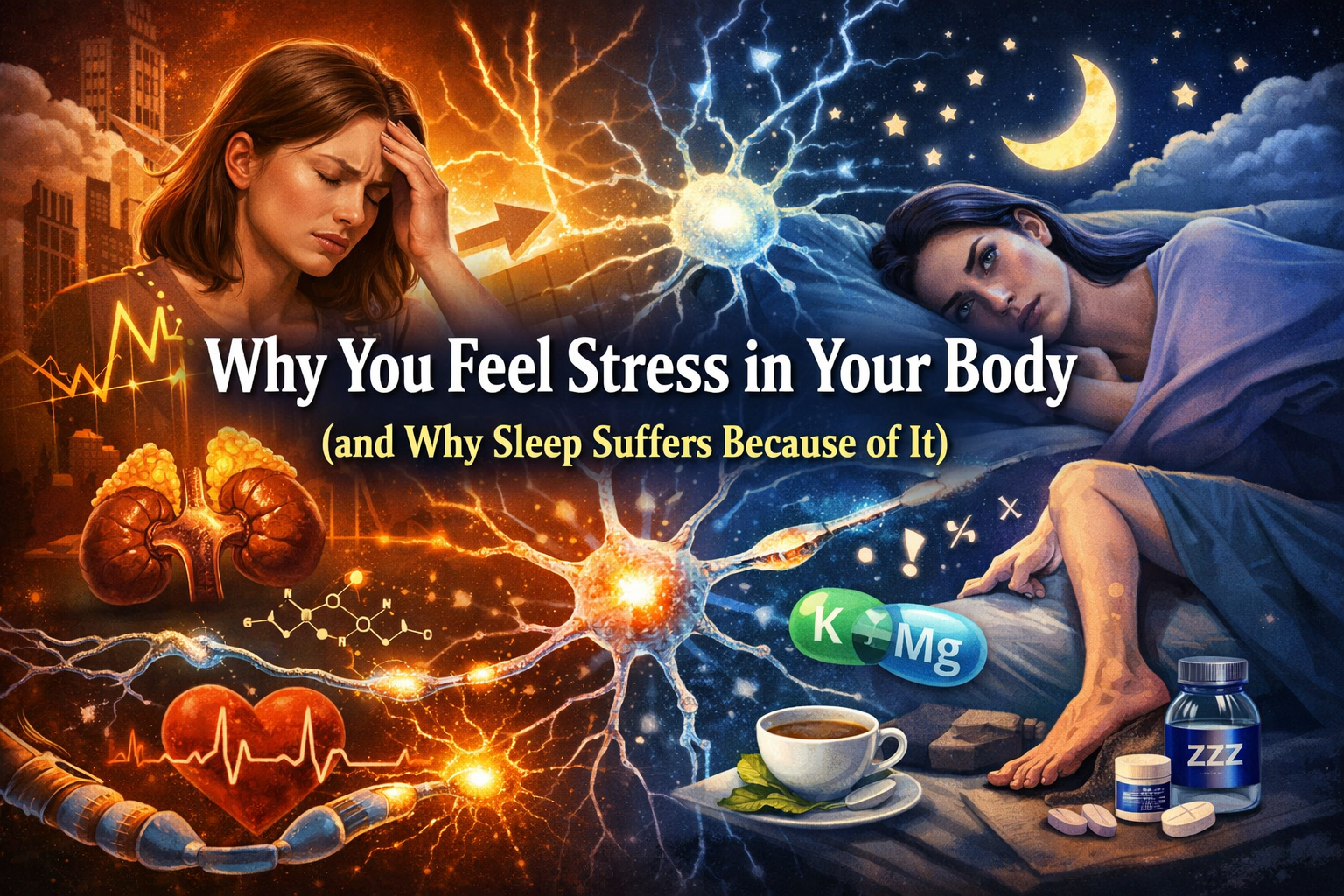
When Stress Stops Being “Just in Your Head”
We’ve all heard it said that stress is mental. That it’s about mindset, perspective, or emotional resilience. And while there is truth to that, it doesn’t fully explain what most people actually experience.
Because real-life stress doesn’t stay in your thoughts.
It settles into your shoulders. It tightens your chest. It shortens your breath. It keeps your mind racing long after your body is begging for rest. It shows up in the middle of the night as twitching legs, a pounding heart, or the frustrating feeling of being completely exhausted but somehow still unable to sleep.
At that point, it becomes obvious that stress is not just psychological. It is deeply physical.
What many people don’t realize is that these physical symptoms are not random. They are the result of how your nervous system is functioning—and more importantly, how well it is supported.
And that support goes far beyond meditation apps or positive thinking. It starts at the cellular level, where your body relies on key nutrients to regulate how your nerves fire, how your muscles relax, and how your body transitions into sleep.
Understanding that connection changes everything, because it shifts the focus from trying to “control stress” to actually supporting the system that processes it.
Your Nervous System Runs on Electrical Signals
Your body is constantly communicating with itself. Every movement, every heartbeat, every breath, and every thought is coordinated through a vast network of nerves sending electrical signals.
This system controls far more than we consciously notice. It determines how tense or relaxed your muscles are. It regulates your heart rhythm. It influences your stress response and dictates when your body is ready to sleep.
When everything is functioning smoothly, these signals are balanced. There is a natural rhythm between activation and recovery, between tension and relaxation.
But when that balance is disrupted, the system becomes noisy.
Signals fire too quickly. Muscles don’t fully relax. The heart may feel like it’s racing even when you’re sitting still. And the brain struggles to switch off at night.
This is where many of the physical sensations of stress originate—not from your thoughts alone, but from the way your nervous system is firing.
Why Stress Drains the Body Faster Than You Think
Stress is not just an emotional experience. It is a full-body biochemical event.
When you are under stress, your body releases hormones like cortisol and adrenaline. These are designed to help you respond quickly and effectively to challenges. In short bursts, this system is incredibly helpful.
But when stress becomes chronic—which is increasingly common in modern life—it begins to take a toll.
Your body shifts into a constant state of demand. It uses more resources to stay alert. It prioritizes immediate survival over long-term recovery. And in the process, it begins to burn through the very things that keep your system balanced.
This is one reason why people often feel increasingly depleted the longer stress persists. It’s not just mental fatigue. It’s physical depletion.
As your body works harder to keep up, it becomes more difficult to return to a calm, regulated state. That’s when symptoms like tension, restlessness, and disrupted sleep begin to appear.
The “Tired but Wired” Experience
One of the most common—and frustrating—experiences people report is feeling completely exhausted during the day, only to feel alert and restless at night.
This is often described as being “tired but wired.”
It doesn’t make sense on the surface. If you’re tired, you should be able to sleep. But the nervous system doesn’t always follow that logic.
When your system is overstimulated, it struggles to shift into its recovery mode. Even if your body is physically worn out, your nerves may still be firing at a higher level than they should be.
That keeps your mind active, your muscles slightly tense, and your body in a state that is not fully ready for sleep.
This pattern is explored further in the article on Great Wellness Reset titled “Why Muscle Fatigue Isn’t About Strength—It’s About Minerals,” which explains how underlying imbalances can create the illusion of fatigue without true recovery.
When your system cannot properly “reset,” rest becomes shallow, fragmented, or delayed altogether.
Why Sleep Is More Than a Brain Function
Many people think of sleep as something that happens in the brain. While the brain plays a central role, sleep is actually a whole-body event.
For sleep to begin and continue smoothly, several things need to happen at once.
Your nervous system needs to reduce its firing rate. Your muscles need to release tension. Your heart rhythm needs to stabilize. Your breathing needs to become slower and deeper.
If any of these systems remain in a heightened state, sleep becomes more difficult.
That’s why you can feel mentally ready for bed but physically unable to settle. Your body hasn’t received—or hasn’t been able to respond to—the signals that it’s safe to power down.
This is also why improving sleep often requires more than simply targeting the brain. It requires supporting the systems that allow the body to relax as a whole.
The Physical Side of Nighttime Restlessness
If you’ve ever experienced leg cramps, muscle twitching, or a general sense of restlessness at night, you know how disruptive it can be.
These symptoms are often dismissed as dehydration, overuse, or simply getting older. But in many cases, they are signs that the body’s communication systems are not functioning optimally.
Muscles rely on precise signaling to contract and release. When that signaling becomes imbalanced, muscles may stay partially contracted or fire unexpectedly.
This can lead to the small but persistent disruptions that prevent deep, restorative sleep.
Over time, these interruptions add up. Even if you are technically sleeping for enough hours, the quality of that sleep may be compromised.
The article “Why Muscle Fatigue Isn’t About Strength—It’s About Minerals” dives deeper into how these physical sensations connect to broader patterns in the body, helping explain why rest sometimes doesn’t feel like recovery.
Why Spring Can Make Everything Feel Worse
Many people expect spring to bring renewed energy and motivation. And in many ways, it does.
But it also introduces a unique set of challenges.
Longer daylight hours can shift your natural rhythms. Increased activity levels place more demand on your body. Schedules often become busier as social events, outdoor activities, and work expectations ramp up.
At the same time, hydration habits may lag behind, and nutritional routines may not fully adjust to the increased demands.
This combination can place additional strain on your nervous system right at the moment when you are trying to do more.
That’s why spring can feel like a paradox. You want to be more active and engaged, but your body may feel more fatigued, more tense, or more restless than expected.
Understanding this seasonal shift can help you approach it with more awareness and better support.

Rethinking the Role of Sleep Aids
When sleep becomes difficult, it’s natural to look for quick solutions.
Products like melatonin or other sleep aids can be helpful in certain situations. They can provide short-term relief and help reset sleep patterns when used appropriately.
But they don’t always address the underlying issue.
If your nervous system is overstimulated, simply trying to force sleep may not create lasting results. The body may still struggle to maintain deep, consistent rest.
That’s why it can be helpful to shift the focus from forcing sleep to supporting the conditions that allow sleep to happen naturally.
When the body is able to relax, sleep tends to follow.
Building the Conditions for Calm
One of the most important mindset shifts is recognizing that calm is not something you impose on your body. It is something your body allows when it feels supported.
That support comes from multiple angles.
Consistent routines help regulate your internal clock. Movement during the day helps release built-up tension. Exposure to natural light reinforces healthy sleep-wake cycles.
And proper nutrition ensures that your body has what it needs to maintain balance at the cellular level.
When these pieces come together, the nervous system becomes more resilient. It can handle stress more effectively during the day and transition more smoothly into rest at night.
This concept is echoed in the article “Potassium, Circulation, and Blood Pressure—What Your Heart Really Needs,” which explores how internal balance supports not just heart health but overall system stability.
Supporting Recovery Instead of Chasing It
So many people spend their time chasing recovery.
They push through long days, rely on caffeine to stay alert, and then look for ways to wind down quickly at night. It becomes a cycle of stimulation followed by forced relaxation.
But real recovery doesn’t work that way.
It’s built gradually, through consistent support of the systems that keep your body in balance.
When your nervous system is functioning well, you don’t have to fight for calm. You don’t have to force sleep. Your body naturally moves into those states because it has the resources it needs to do so.
This is the foundation of long-term resilience.
Final Thoughts: Listen to What Your Body Is Saying
If stress feels physical, that’s because it is.
Those tight muscles, restless nights, and racing thoughts are not just inconveniences. They are signals. They are your body’s way of telling you that something in the system needs support.
Instead of trying to override those signals, it can be far more effective to listen to them.
To recognize that your nervous system is doing its best to keep up with the demands placed on it—and that it may simply need better support to function the way it was designed to.
As life speeds up, especially during seasons like spring, that support becomes even more important.
Because when your body is balanced, everything changes. Stress becomes more manageable. Sleep becomes more restorative. And you begin to feel not just less overwhelmed, but more in control of your energy, your focus, and your overall well-being.
References
National Institute of Neurological Disorders and Stroke. “Brain Basics: The Life and Death of a Neuron.” https://www.ninds.nih.gov
Harvard Health Publishing. “Understanding the Stress Response.” https://www.health.harvard.edu
American Psychological Association. “Stress Effects on the Body.” https://www.apa.org
Sleep Foundation. “Why Can’t I Sleep? Causes of Insomnia.” https://www.sleepfoundation.org
Cleveland Clinic. “Muscle Cramps and What Causes Them.” https://my.clevelandclinic.org
Great Wellness Reset. “Why Muscle Fatigue Isn’t About Strength—It’s About Minerals.” https://greatwellnessreset.com/why-muscle-fatigue-isnt-about-strength-its-about-minerals/
Great Wellness Reset. “Potassium, Circulation, and Blood Pressure—What Your Heart Really Needs.” https://greatwellnessreset.com/potassium-circulation-and-blood-pressure-what-your-heart-really-needs/