August 18, 2026
Understanding Enzymes: Why They Matter for Digestion and Wellness
What Are Enzymes?
Enzymes are primarily proteins that act as biological catalysts. A catalyst helps a chemical reaction occur more efficiently without being consumed by the reaction itself.
That sounds technical, but the basic idea is surprisingly simple.
Your body is constantly carrying out chemical reactions. Some build things, some break things apart, and others help convert one substance into another. Enzymes help those reactions happen at rates compatible with normal biological function.
Different enzymes are designed to interact with different substances. This specificity is one reason there are so many different enzymes in the human body.
Digestion provides an easy example.
When you eat a meal containing protein, your body needs to break those large protein molecules into smaller peptides and eventually amino acids. Proteolytic enzymes, including proteases, participate in that process.
Carbohydrates require different enzymes. Fats require still others.
That’s why talking about “enzymes” as though they all do exactly the same thing can be misleading. An enzyme’s function depends on the particular enzyme and the substance with which it interacts.
Why Are Enzymes Important for Digestion?
Imagine eating a meal containing grilled chicken, vegetables, avocado and brown rice.
Your body doesn’t simply absorb a piece of chicken and send it to your muscles or take a grain of rice and convert it directly into energy.
The digestive process first has to break the meal apart.
Proteins are progressively broken into smaller peptides and amino acids. Carbohydrates are broken into simpler sugars. Dietary fats are broken into fatty acids and other components.
Once nutrients have been sufficiently broken down, they can become available for absorption and subsequent use by the body.
This gives us a helpful way to think about nutrition:
Food → Digestion → Nutrient Breakdown → Nutrient Utilization
Choosing nutritious foods remains essential, but digestion is part of the journey between what is on your plate and what ultimately becomes available to your body.
Enzymes are one of the tools the body uses to accomplish that work.
Your Body Already Produces Digestive Enzymes
It’s important to clarify something that supplement advertising sometimes overlooks: your body naturally produces digestive enzymes.
Digestion begins before food ever reaches the intestines.
Salivary enzymes begin working in the mouth. The stomach provides an acidic environment and enzymes involved in protein digestion. The pancreas releases several important digestive enzymes into the small intestine, where much of the breakdown of carbohydrates, proteins and fats continues.
The small intestine also contains enzymes that participate in the final stages of digestion.
In other words, digestive enzymes aren’t foreign to the human body. They are already part of normal physiology.
Supplemental enzymes are intended to complement these natural digestive processes rather than replace them.
Digestive Enzymes and Systemic Enzymes: What’s the Difference?
This is where enzyme supplementation can become confusing.
You’ll frequently encounter two terms:
Digestive enzymes and systemic enzymes.
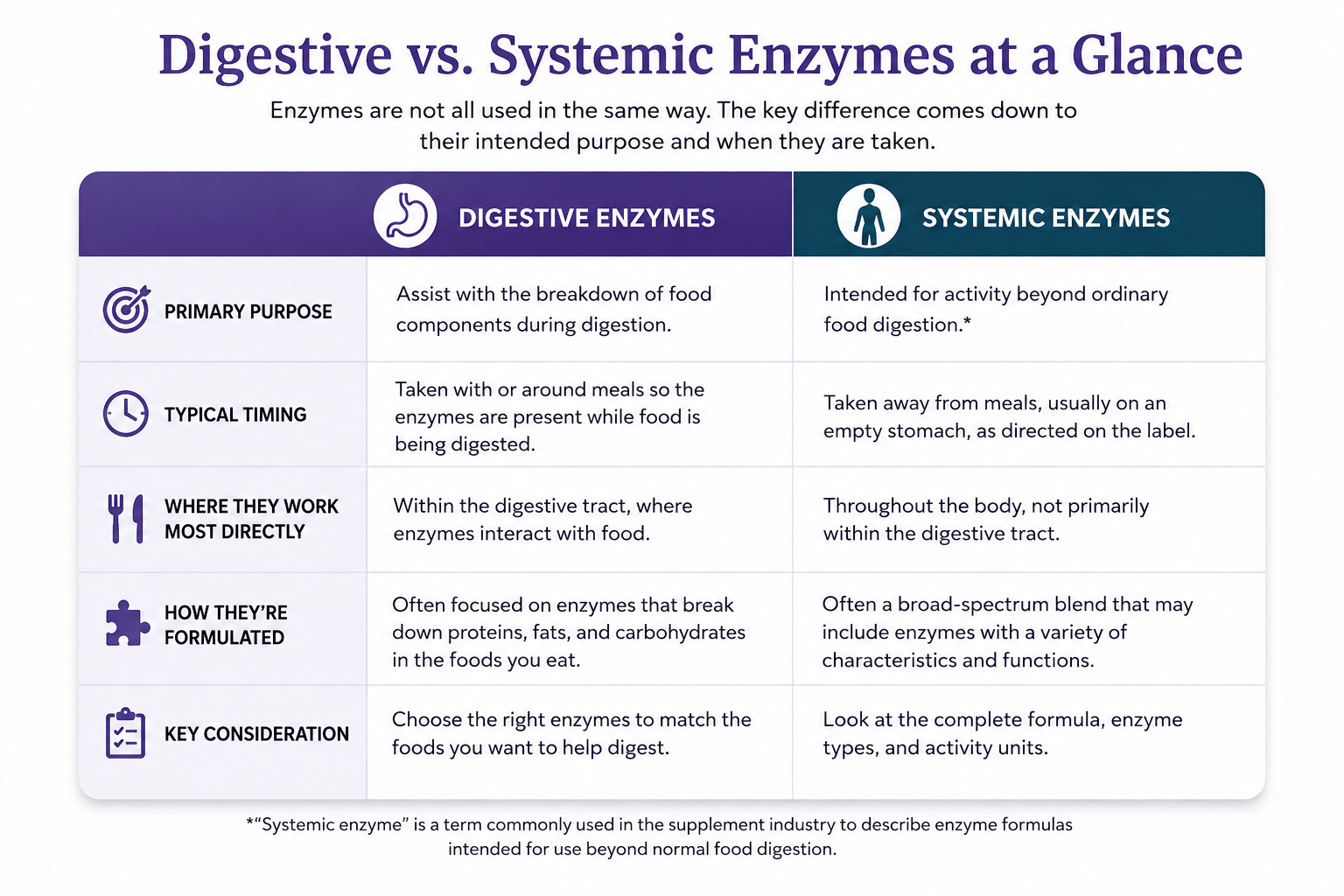
The distinction generally has less to do with enzymes belonging to two completely separate biological categories and more to do with how particular enzymes are being used and when they are consumed.
Digestive Enzymes
Digestive enzyme supplements are generally intended to be taken with or around meals.
Their primary purpose is straight forward: they are present in the digestive tract at the same time as food and participate in breaking components of that meal into smaller substances.
For example, proteases act on proteins. Lipases act on fats. Amylases act on starches and carbohydrates.
This is the traditional digestive-enzyme model:
You eat → enzymes encounter the food → food components are broken down.
If someone purchases a typical digestive enzyme supplement, the label will commonly direct them to take it shortly before or with a meal because food digestion is the intended use.
Systemic Enzymes
“Systemic enzymes” is a term commonly used in the supplement industry for enzyme formulations intended to be taken away from meals.
Rather than being consumed primarily to participate in the digestion of a meal, these formulations are positioned around enzyme activity beyond ordinary food digestion.
This distinction is important because many claims made online about systemic enzymes extend far beyond what has been conclusively established for particular supplemental formulations.
Research has investigated various proteolytic enzymes and enzyme preparations for uses beyond food digestion, but the evidence depends heavily on the specific enzyme, dose, formulation and outcome being studied. It is therefore better to understand systemic enzyme supplementation as an evolving area of research rather than assume that every proposed benefit applies to every enzyme product.
That distinction becomes especially important when evaluating an enzyme formula.
Why Do Enzyme Formulas Contain More Than One Enzyme?
Enzymes are selective.
An enzyme that acts on one type of molecule may not perform the same function with another. This is one reason broad-spectrum enzyme formulations combine multiple enzyme types instead of relying on a single ingredient.
Think about a toolbox.
A screwdriver and a wrench are both tools, but they aren’t interchangeable. Having several specialized tools gives you different capabilities.
Enzymes work on a much more sophisticated biological level, but the analogy helps explain why an enzyme supplement may contain a blend.
A broad-spectrum formulation can combine enzymes with different characteristics, sources and substrate specificities into a single product.
The ingredient panel is therefore much more informative than simply seeing the words “enzyme supplement” on the front of a bottle.
Meet ProOneZyme: A Broad-Spectrum Enzyme Formula
This brings us to ProOneZyme.
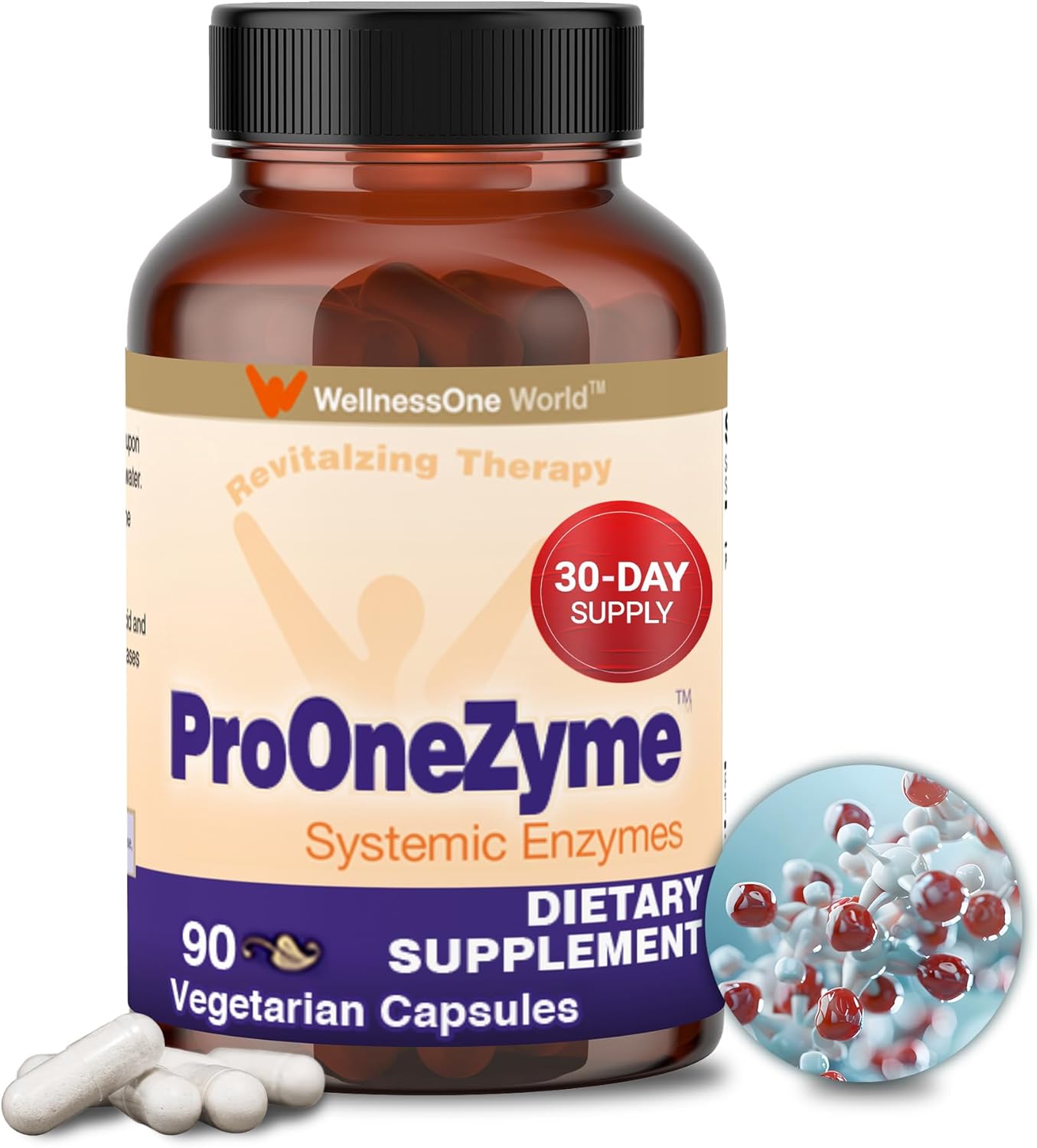
ProOneZyme is labeled as a systemic enzyme dietary supplement and contains 90 vegetarian capsules per bottle. Rather than being built around a single enzyme, the formula combines multiple specialized ingredients in one product.
The important question isn’t simply whether ProOneZyme contains enzymes.
It’s which enzymes are included and what makes those ingredients different from one another.
What’s Inside ProOneZyme?
Understanding an enzyme supplement becomes much easier when you look beyond the front of the bottle and examine the formula itself.
ProOneZyme is a broad-spectrum systemic enzyme formula containing several enzymes with different characteristics and activities. Rather than building the formula around one enzyme, ProOneZyme brings several specialized enzymes together in a single vegetarian-capsule formula.
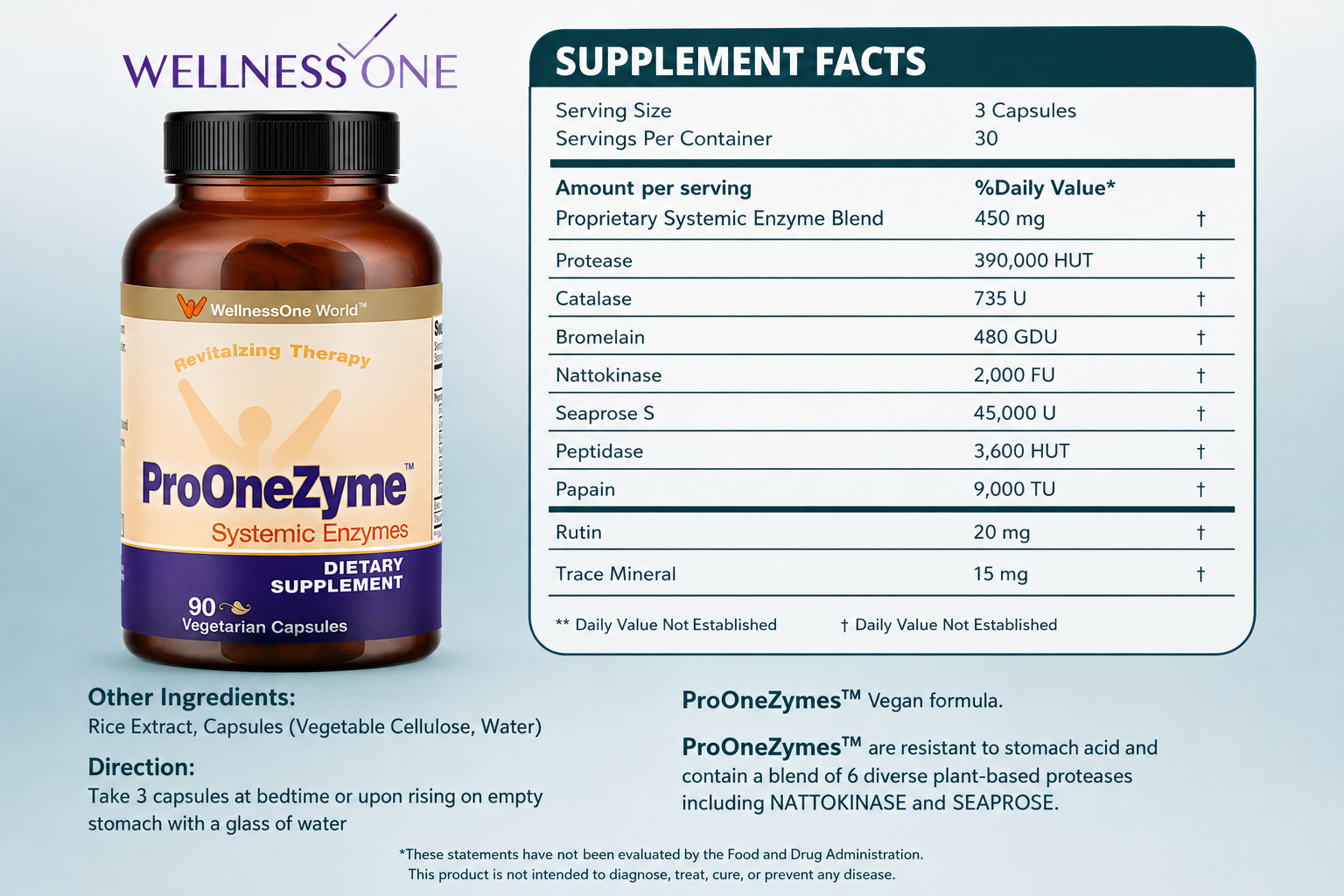
A serving is 3 capsules, and each bottle contains 30 servings, or 90 capsules.
The Supplement Facts panel lists a 450 mg Proprietary Systemic Enzyme Blend containing Protease, Catalase, Bromelain, Nattokinase, Seaprose S, Peptidase, and Papain. The formula also contains Rutin and Trace Mineral.
Let’s take a closer look at what those ingredients actually are.
Protease — 390,000 HUT
Protease isn’t a single enzyme but a general term for enzymes that act on proteins.
Proteins are made from long chains of amino acids joined together by peptide bonds. Proteolytic enzymes help break those bonds, producing smaller peptides and amino acids.
Proteases are therefore closely associated with protein breakdown during digestion. However, proteolytic enzymes are also among the enzymes researchers have studied in contexts beyond ordinary food digestion.
The ProOneZyme formula provides protease activity of 390,000 HUT per serving.
HUT stands for Hemoglobin Unit on the Tyrosine basis, an activity measurement used for certain proteolytic enzymes. This illustrates an important point when comparing enzyme supplements: enzyme activity can be more informative than looking only at an ingredient’s weight in milligrams.
Catalase — 735 U
Catalase is an enzyme naturally present in living organisms, including the human body.
Its biological role involves converting hydrogen peroxide into water and oxygen. Hydrogen peroxide is naturally generated through normal cellular processes, and catalase is part of the body’s enzyme systems for managing it.
The formula provides 735 U of catalase activity per serving.
Catalase is a useful example of why enzymes shouldn’t all be viewed simply as “digestive enzymes.” Enzymes participate in an enormous variety of biological reactions, and their functions depend upon the particular enzyme involved.
Bromelain — 480 GDU
Bromelain refers to a group of proteolytic enzymes derived from pineapple, particularly the stem and fruit of the plant.
Because bromelain is proteolytic, it has the ability to act on proteins. It has a long history of use in enzyme formulations and has also been the subject of scientific research.
ProOneZyme provides 480 GDU of bromelain activity per serving.
GDU stands for Gelatin Digesting Units, another example of an enzyme activity measurement. Rather than simply telling you how many milligrams of bromelain are present, the activity measurement describes its ability to perform a particular enzymatic reaction under standardized conditions.
Nattokinase — 2,000 FU
Nattokinase is an enzyme associated with natto, a traditional Japanese food produced by fermenting soybeans with Bacillus subtilis var. natto.
During fermentation, the microorganism produces nattokinase.
This ingredient has attracted considerable scientific attention and is one of the more distinctive enzymes in the ProOneZyme formula.
The product provides 2,000 FU of nattokinase activity per serving. FU is the standardized activity unit commonly used to measure nattokinase enzyme activity.
You may encounter much stronger health claims about nattokinase online. It’s important to distinguish ongoing research into an isolated ingredient from claims that a dietary supplement can prevent or treat a medical condition. The presence of nattokinase in a supplement should not be interpreted as evidence that the product can diagnose, treat, cure, or prevent disease.
Seaprose S — 45,000 U
Seaprose S is a specialized proteolytic enzyme, meaning that it acts on proteins.
It is considerably less familiar to most consumers than enzymes such as bromelain and papain, which is one reason it can stand out when comparing enzyme formulations.
ProOneZyme provides 45,000 U of Seaprose S activity per serving.
Like other proteolytic enzymes, Seaprose has been investigated scientifically for uses beyond basic food digestion. Those areas of research should be separated from the established fact that Seaprose is a proteolytic enzyme and from any claims about what a particular dietary supplement will do in an individual.
Peptidase — 3,600 HUT
Peptidases are enzymes involved in breaking peptide bonds.
During protein digestion, large proteins are progressively broken into smaller peptides and ultimately into amino acids. Peptidases participate in this protein-breakdown process.
ProOneZyme provides 3,600 HUT of peptidase activity per serving.
The presence of both protease and peptidase illustrates the broad-spectrum approach of the formula: different enzymes can act at different points in the breakdown of proteins and peptides.
Papain — 9,000 TU
Papain is a proteolytic enzyme derived from the papaya plant (Carica papaya).
Like bromelain, papain has a long history of use because of its ability to break down proteins. It is commonly encountered in digestive enzyme formulations and has also been used in food processing because of its proteolytic properties.
ProOneZyme provides 9,000 TU of papain activity per serving.
Again, the activity units are important. Enzymes are functional proteins, so evaluating them involves more than simply comparing the weight of one ingredient with another.
Rutin — 20 mg
Rutin is different from the enzymes we’ve just discussed.
It is a naturally occurring plant bioflavonoid, or flavonoid glycoside, found in a variety of plants and foods.
ProOneZyme contains 20 mg of rutin per serving.
Including rutin alongside the enzyme blend further distinguishes the overall formulation from a basic single-enzyme digestive supplement.
Trace Mineral — 15 mg
The Supplement Facts panel also lists 15 mg of Trace Mineral per serving.
Because the current label identifies this ingredient only as “Trace Mineral” and does not specify individual minerals on the Supplement Facts panel, we shouldn’t claim that it contains particular minerals unless the manufacturer has documentation identifying them.
That’s an important principle when evaluating any supplement: the label should remain the source of truth.
Why Enzyme Activity Units Matter
You may have noticed something unusual about the ProOneZyme Supplement Facts panel.
Instead of listing every enzyme only in milligrams, it provides measurements such as:
390,000 HUT • 480 GDU • 2,000 FU • 45,000 U • 3,600 HUT • 9,000 TU
There’s a reason for that.
Enzymes perform specific biochemical reactions. Simply knowing the physical weight of an enzyme preparation doesn’t necessarily tell you how much enzymatic activity it provides.
Activity units are determined using standardized testing methods that measure an enzyme’s ability to perform a particular reaction under defined conditions.
When comparing enzyme formulas, don’t look only at milligrams. Consider the specific enzymes included, their stated activity units, intended use, and product directions.
Why Timing Matters With Enzyme Supplements
One of the most common questions about enzymes is whether they should be taken with food or on an empty stomach.
The answer depends on the intended use and the product directions.
An enzyme intended primarily for digestion generally needs to be present when food is being digested, which is why many digestive enzyme products are taken with meals.
Systemic enzyme products are commonly directed to be taken away from meals because their intended purpose isn’t primarily the digestion of the food you’ve just consumed.
That doesn’t mean consumers should create their own dosing schedules based on something they read online. The appropriate approach is to follow the directions provided for the specific product and discuss questions with a qualified healthcare professional.
How to Evaluate an Enzyme Supplement
Not all enzyme supplements are formulated the same way. When comparing products, look beyond the front of the bottle and check the Supplement Facts panel.
Consider which enzymes are included, whether the product contains a single enzyme or a broader blend, and whether the directions call for taking it with meals or away from food.
Also look beyond milligrams. Enzymes are often measured by activity units, which provide useful information about their enzymatic activity.
In short, focus on the enzymes, their activity, the intended use, and the directions—not just the size of the serving.
Frequently Asked Questions About Enzymes
Are digestive enzymes and systemic enzymes the same thing?
Not exactly. The terms generally describe different intended uses. Digestive enzymes are typically used around meals to participate in food digestion. “Systemic enzyme” is a supplement-industry term generally used for enzyme formulations intended to be taken away from meals for purposes beyond ordinary food digestion.
Some of the same types of enzymes may appear in different formulations, which is why the complete formula and product directions matter.
Does the body naturally make enzymes?
Yes. The human body produces a large number of enzymes involved in digestion, metabolism and many other biological processes. Digestive enzymes are produced in several parts of the digestive system, including the mouth, stomach, pancreas and small intestine.
Are all digestive enzymes the same?
No. Different enzymes act on different substrates. Proteases act on proteins, lipases on fats and amylases on starches, for example. That’s one reason broad-spectrum digestive formulas often contain multiple enzymes.
Why are some enzyme supplements taken with meals and others away from food?
It depends on their intended use. Products intended to assist with food digestion are generally taken around meals. Products marketed as systemic enzyme formulas are generally directed to be taken away from food.
Always follow the directions for the specific product.
Does taking more enzymes mean better results?
Not necessarily. More isn’t automatically better with supplements. Enzyme type, activity, formulation, intended use and individual circumstances all matter.
Can everyone take enzyme supplements?
Not necessarily. Dietary supplements can interact with medications and may not be appropriate for everyone. This is particularly important with certain specialized enzyme ingredients. People who take prescription medications, have medical conditions, are pregnant or nursing, or are preparing for a medical procedure should discuss dietary supplements with their healthcare professional before use.
Why is ProOneZyme taken on an empty stomach?
ProOneZyme is labeled as a systemic enzyme formula rather than a traditional digestive enzyme intended to accompany a meal. According to the product directions, three capsules should be taken at bedtime or upon rising on an empty stomach with a glass of water. Always follow the directions provided on the product label.
Ready to Take a Closer Look at ProOneZyme?
You’ve learned how enzymes work, how digestive and systemic enzyme approaches differ, and what makes up the ProOneZyme formula.
Explore the complete product details, suggested use, current pricing, and purchasing options at Procelle.
90 Vegetarian Capsules | 30 Servings Per Bottle
Continue to Procelle.com for complete product and purchasing information.
Dietary supplements are not intended to diagnose, treat, cure, or prevent disease. Consult a qualified healthcare professional if you have questions about whether a dietary supplement is appropriate for you.
Your Body Depends on Enzymes Every Day
When most people think about healthy nutrition, they naturally think about the food on their plate. More vegetables. Better sources of protein. Less processed food. More whole foods.
Those choices certainly matter. But eating nutritious food is only the beginning of the process.
Before your body can make use of much of what you eat, food has to be broken down into smaller components. The proteins, fats and carbohydrates in a meal aren’t simply absorbed exactly as they appear on your plate. Your digestive system has to process them first.
Enzymes are an important part of making that possible.
You can think of enzymes as specialized biological helpers. They facilitate chemical reactions throughout the body, including many of the reactions involved in digestion.
Understanding what enzymes do—and recognizing that not all enzymes perform the same job—can make the entire subject of digestive and systemic enzyme supplements much easier to understand.