
Are You Tired but Wired?
When Sleep Looks Right but Feels Wrong
You did everything right.
You went to bed at a reasonable time. The lights are off. The room is quiet. Your phone is out of reach. On the surface, it looks like the perfect setup for a good night’s sleep.
And yet, something feels off.
Your legs twitch. Your muscles feel tight instead of loose. Your body is tired, but your mind won’t fully shut down. You drift in and out of sleep, only to wake up feeling like you never truly rested.
This experience is incredibly common, and it’s often brushed off as stress, aging, or just “one of those things.” But those explanations don’t go far enough.
What’s actually happening is deeper. It’s not just about sleep habits or mental stress. It’s about your nervous system’s ability to relax—and when that system isn’t functioning properly, your body simply can’t fully power down.
One of the most overlooked pieces of this puzzle is mineral balance, particularly potassium.
If you’ve ever wondered how mineral balance impacts deeper systems like circulation and recovery, you may find it helpful to explore this breakdown on how electrolytes influence overall function:
https://greatwellnessreset.com/potassium-circulation-and-blood-pressure-what-your-heart-really-needs/
Relaxation Isn’t Passive—It’s Something Your Body Has to Do
Most people think of relaxation as doing nothing. Sitting still. Lying down. Closing your eyes.
But biologically, relaxation is not passive. It’s an active process your body has to perform.
For your body to truly relax, your nervous system must reduce stimulation, your muscles must release tension, your heart rhythm must stabilize, and your body must shift into a parasympathetic state—the state responsible for rest and recovery.
All of this depends on electrical signaling inside the body.
Potassium plays a central role in that signaling. Without it, your body struggles to transition into a calm, relaxed state.
This connection between the nervous system and physical symptoms is explored more deeply in this article on how stress becomes physical:
https://greatwellnessreset.com/why-stress-feels-physical-the-mineral-connection-between-your-nervous-system-and-sleep/
Why Your Muscles Won’t Let Go
Muscles don’t automatically relax after contraction. They require a signal from your nervous system telling them to release.
That signal depends on proper electrolyte balance.
Potassium helps regulate the electrical gradient across cell membranes, allowing muscles to reset after contraction. When potassium is low or imbalanced, that reset signal weakens.
The result is not dramatic dysfunction, but subtle, persistent tension.
This is when people notice tight calves, twitching legs, foot cramps, or restlessness that seems to come out of nowhere—especially at night.
If muscle fatigue or tension is something you’ve experienced during activity as well, this related article explains why it’s not always about strength:
https://greatwellnessreset.com/why-muscle-fatigue-isnt-about-strength-its-about-minerals/
Why It Always Seems Worse at Night
During the day, movement masks underlying imbalances.
At night, everything changes.
Your body stops moving. Your nervous system attempts to slow down. Recovery processes begin.
If your body lacks the resources it needs to fully relax, symptoms surface right at that moment.
That’s why many people feel fine during the day but experience discomfort as soon as they lie down.
Nighttime symptoms are not random. They are signals.
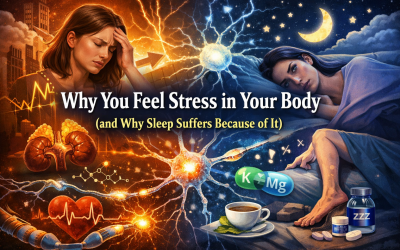
Stress Doesn’t Just Feel Mental—It Becomes Physical
Stress is often described as mental, but it has very real physical consequences.
When stress levels rise, your body releases cortisol. While helpful in short bursts, chronic elevation of cortisol increases the loss of essential minerals, including potassium.
Even everyday stress—busy schedules, caffeine, inconsistent hydration, and poor sleep—can gradually deplete your system.
Over time, this leads to a nervous system that is more reactive and less able to calm itself.
This is why stress often shows up physically before it is fully recognized mentally.
For a deeper look at how modern habits contribute to nervous system overload, this article provides helpful insight:
https://greatwellnessreset.com/screen-time-is-now-considered-a-major-health-factor/
Understanding the “Tired but Wired” Feeling
Feeling exhausted yet unable to relax is one of the most common complaints in modern life.
This paradox reflects a nervous system that is overstimulated but under-supported.
Potassium plays a key role in nerve repolarization—the process that allows nerves to reset after firing.
When that reset doesn’t happen efficiently, your body remains in a semi-activated state.
Your thoughts continue cycling. Your muscles remain slightly tense. Your sleep becomes shallow and fragmented.
This pattern often overlaps with broader sleep and mental health challenges, which are explored further here:
https://greatwellnessreset.com/sleep-and-mental-health-how-rest-restores-the-brain-and-body/
Stress Doesn’t Just Feel Mental—It Becomes Physical
Stress is often described as mental, but it has very real physical consequences.
When stress levels rise, your body releases cortisol. While helpful in short bursts, chronic elevation of cortisol increases the loss of essential minerals, including potassium.
Even everyday stress—busy schedules, caffeine, inconsistent hydration, and poor sleep—can gradually deplete your system.
Over time, this leads to a nervous system that is more reactive and less able to calm itself.
This is why stress often shows up physically before it is fully recognized mentally.
For a deeper look at how modern habits contribute to nervous system overload, this article provides helpful insight:
https://greatwellnessreset.com/screen-time-is-now-considered-a-major-health-factor/

Understanding the “Tired but Wired” Feeling
Feeling exhausted yet unable to relax is one of the most common complaints in modern life.
This paradox reflects a nervous system that is overstimulated but under-supported.
Potassium plays a key role in nerve repolarization—the process that allows nerves to reset after firing.
When that reset doesn’t happen efficiently, your body remains in a semi-activated state.
Your thoughts continue cycling. Your muscles remain slightly tense. Your sleep becomes shallow and fragmented.
This pattern often overlaps with broader sleep and mental health challenges, which are explored further here:
https://greatwellnessreset.com/sleep-and-mental-health-how-rest-restores-the-brain-and-body/
Why Quick Fixes Don’t Last
Stretching, massage, and other physical techniques can provide temporary relief.
But if the nervous system lacks the internal support it needs, those benefits are short-lived.
The tension returns because the underlying signaling environment hasn’t changed.
Addressing the root cause requires supporting the body at a deeper level—where the signals themselves are generated.
Sleep Isn’t About Sedation—It’s About Readiness
Many solutions for sleep focus on sedation, helping you fall asleep quickly.
But falling asleep is only one part of the equation.
True sleep quality depends on your body being ready to rest.
Potassium supports that readiness by helping regulate nerve activity, muscle relaxation, heart rhythm, and cellular hydration.
When these systems are functioning properly, sleep becomes more natural, deeper, and more restorative.
Why Spring Can Make Everything Feel Worse
Seasonal changes can amplify these issues.
Spring brings longer days, increased activity, and shifting routines. At the same time, hydration habits and mineral intake often become inconsistent.
This creates a gap between demand and support.
Your body is doing more, but it isn’t necessarily receiving what it needs to recover.
That mismatch often shows up as restlessness, tension, and disrupted sleep.
The Power of Supporting the System
Sleep is not something you force. It’s something your body allows.
When your muscles can relax, your nerves can calm down, and your internal balance is restored, sleep becomes easier.
Supporting your body at the foundational level changes everything.
Instead of chasing sleep, you create the conditions where sleep naturally occurs.
Final Thoughts
If your body won’t fully relax at night—if cramps, twitching, or restlessness are interfering with your sleep—it’s worth looking deeper.
It may not be your routine. It may not be your mindset.
It may be that your nervous system simply doesn’t have what it needs.
When you support the systems responsible for relaxation, you shift from struggling to sleep to allowing sleep.
And that’s where real recovery begins.
References
- Institute of Medicine (US) Panel on Dietary Reference Intakes for Electrolytes and Water. Dietary Reference Intakes for Water, Potassium, Sodium, Chloride, and Sulfate.
- Gennari, F. J. “Hypokalemia.” New England Journal of Medicine, 1998.
- Clausen, T. “Role of Na⁺, K⁺-pumps in muscle function.” Physiological Reviews, 2003.
- National Institutes of Health (NIH). Potassium Fact Sheet for Health Professionals.
- Abbasi, B. et al. “Magnesium supplementation and insomnia.” Journal of Research in Medical Sciences, 2012.
- Whelton, P. K. et al. “Effects of potassium on blood pressure.” JAMA, 1997.
- Walker, M. Why We Sleep. Scribner, 2017.

0 Comments