
How Potassium Helps Regulate Blood Pressure and Heart Rhythm
Discover how potassium helps regulate fluid balance, relax blood vessels, and support steady heart rhythm for long-term cardiovascular wellness.
Steady Heart Rhythm
Relax Blood Vessels
Relaxed blood vessels allow blood to flow more easily, helping reduce pressure and support smooth circulation.
Sometimes the heart needs more — not less.
When people think about heart health, the conversation usually revolves around what to avoid. Avoid too much salt. Avoid too much fat. Avoid too much stress. Avoid whatever new headline is circulating this week.
But long-term cardiovascular health isn’t built on avoidance alone. It’s built on support.
Your heart is working for you every second of every day. It doesn’t just need the absence of harm — it needs the right internal environment to function efficiently. One of the most overlooked nutrients that helps create that environment is potassium.
Potassium rarely gets the spotlight. It isn’t as dramatic as cholesterol numbers or as widely discussed as blood pressure medication. Yet this mineral quietly influences circulation, fluid balance, vessel flexibility, and heart rhythm every moment of the day.
If your goal is to support your cardiovascular system long-term, potassium deserves a closer look.


Most people think of the heart as a pump. And it is — but that’s only part of the story.
Before the heart can pump, it has to fire. Each heartbeat begins with an electrical impulse. That impulse travels through specialized tissue, triggering heart muscle cells to contract in a coordinated pattern. After contraction, those cells must reset electrically before the next beat can occur.
This electrical signaling depends heavily on electrolytes — especially potassium.
Potassium helps regulate the movement of charged particles in and out of heart cells. This movement creates the electrical gradient necessary for a heartbeat to start and stop properly. Without an appropriate potassium balance, that rhythm can feel off.
The heart’s ability to contract, relax, and reset relies on precise potassium regulation. It’s not dramatic work — but it’s essential work.
Circulation Begins in the Cells
Circulation Starts at the Cellular Level
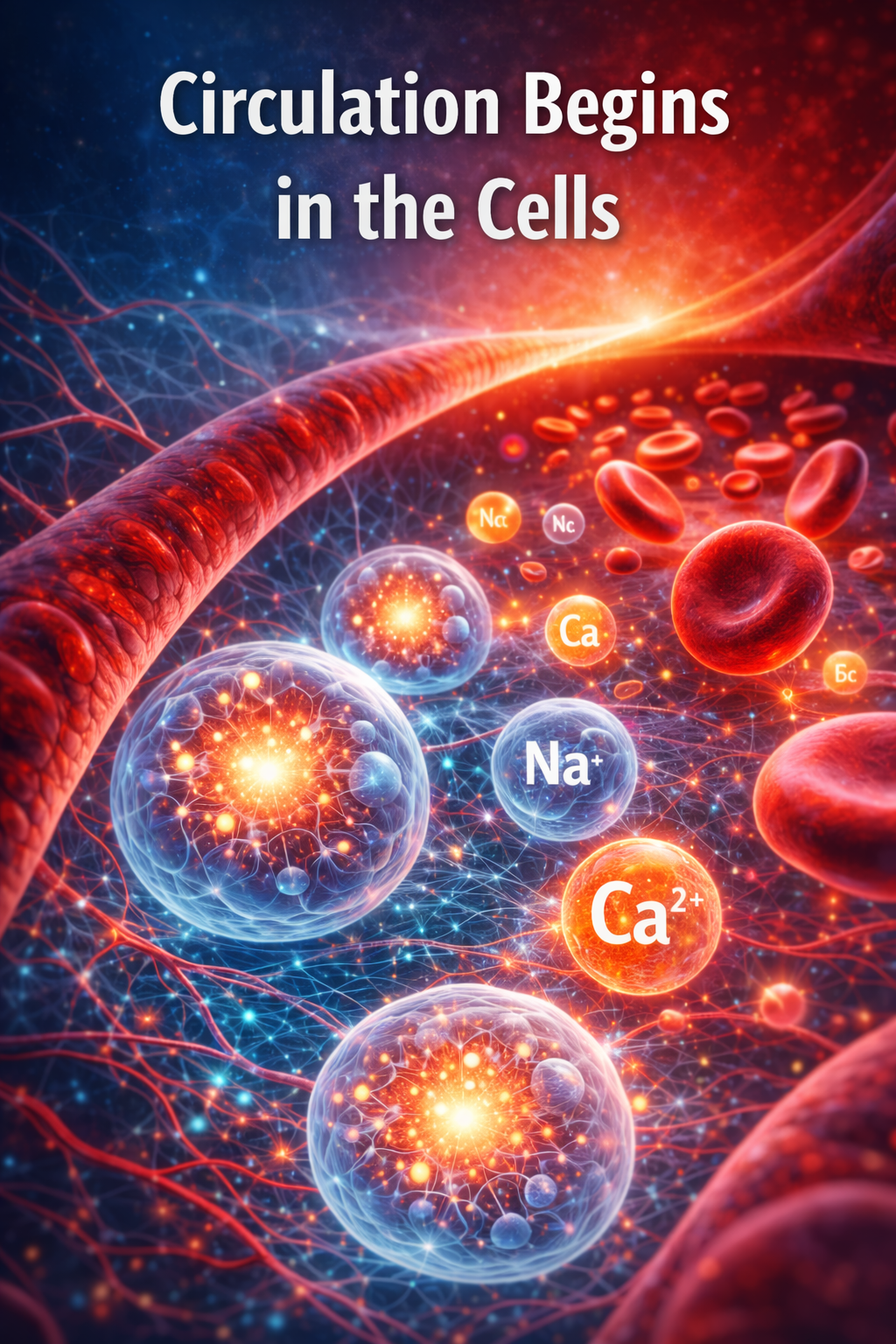
When we talk about circulation, we often picture arteries and veins. But circulation is more than plumbing. It’s dynamic, responsive, and cellular.
Healthy circulation means blood flows smoothly, oxygen reaches tissues efficiently, nutrients are delivered where needed, and waste products are removed promptly. For this to happen, blood vessels must constantly adjust their diameter — tightening and relaxing based on demand.
Potassium plays a role in this process by influencing smooth muscle function in blood vessel walls. When potassium levels are adequate, vessels are better able to relax appropriately, supporting smoother blood flow. When potassium is low, vessels may remain more constricted, increasing resistance within the system.
This doesn’t necessarily mean disease is present — but it can mean the cardiovascular system is working harder than it needs to.

Potassium and Blood Pressure: A Regulatory Relationship
Blood pressure is influenced by several interacting systems: fluid volume, vessel flexibility, kidney function, nervous system activity, and electrolyte balance.
Potassium supports this system in multiple ways.
First, it helps counterbalance sodium’s fluid-retaining effects. Sodium is essential — it helps regulate nerve signaling and muscle contraction — but modern diets often contain far more sodium than potassium. This imbalance can shift fluid distribution in a way that increases pressure within vessels.
Second, potassium supports the kidneys’ ability to regulate fluid and sodium balance. Adequate potassium intake is associated with healthier blood pressure patterns, particularly when sodium intake is moderate to high (Whelton et al., 1997).
Large epidemiological studies have shown that higher dietary potassium intake is associated with lower risk of stroke and improved cardiovascular outcomes (D’Elia et al., 2011; Aburto et al., 2013). Importantly, potassium does not “force” blood pressure down — it supports the body’s natural regulatory mechanisms so that pressure can remain within a healthy range.
It’s not about overpowering the system. It’s about restoring balance within it.
Sodium Isn’t the Enemy — Imbalance Is
Sodium often gets blamed as the villain in cardiovascular health. But sodium is not optional. It’s necessary for survival.
The real issue is the ratio.
Historically, human diets contained significantly more potassium than sodium. Today, the pattern is often reversed. Processed foods increase sodium intake, while lower fruit and vegetable consumption reduces potassium intake. This reversal disrupts a mineral relationship that evolved to work in harmony.
Research consistently shows that the sodium-to-potassium ratio is more predictive of cardiovascular risk than sodium alone (Cook et al., 2009). In other words, it’s the imbalance that creates strain — not sodium by itself.
When potassium intake improves, the body can manage sodium more efficiently. Fluid balance stabilizes. Vessels respond more appropriately. The heart’s electrical system operates with less tension.
Balance, not elimination, is the key.
What Changes as We Age
As the body ages, blood vessels naturally lose some flexibility. Muscle mass declines. Kidney efficiency may shift slightly. Digestive absorption can change. Stress exposure accumulates.
These changes don’t automatically lead to disease — but they can reduce physiological resilience.
Some people begin to notice subtle signs of circulatory inefficiency over time: colder hands and feet, mild swelling in the ankles, fatigue during activity, or increased sensitivity to dehydration.
Maintaining adequate potassium intake becomes increasingly important because it supports vessel relaxation, muscle efficiency, and fluid regulation — three systems that naturally require more support with age.
This is not about reversing time. It’s about maintaining function.
Heart Rhythm and Electrolyte Awareness
Occasional awareness of heartbeat — such as fluttering or skipped beats — can sometimes be linked to electrolyte imbalance rather than structural heart disease. Potassium plays a critical role in the heart’s “reset phase” between beats.
When potassium levels fall too low (a condition known as hypokalemia), the heart’s electrical system can become disrupted. Potassium is essential for the “reset phase” between heartbeats — a process called electrical repolarization. If potassium is insufficient, this reset can become delayed or irregular.
In more severe cases, this disruption may contribute to arrhythmias, which are irregular heart rhythms. Arrhythmias occur when the heart beats too fast, too slow, or unevenly due to abnormal electrical signaling. Some people describe them as fluttering, skipped beats, racing, or pounding sensations in the chest. While mild rhythm changes can sometimes be temporary, more significant arrhythmias may require medical evaluation (Gennari, 1998).
It’s important to note that both low and excessively high potassium levels can affect rhythm, which is why balance — not excess — is crucial. Anyone experiencing persistent rhythm irregularities should consult a healthcare professional. However, ensuring adequate dietary potassium intake is a foundational step in supporting electrical stability.
Stress Quietly Depletes Potassium
Chronic stress activates the sympathetic nervous system — increasing heart rate, tightening blood vessels, and shifting fluid distribution. Over time, stress hormones can also increase urinary excretion of potassium.
This means that during prolonged stress, the body may lose more potassium than usual. If intake doesn’t keep pace with demand, subtle imbalances can develop.
The result? The cardiovascular system may feel more reactive. Heart rate increases more easily. Blood pressure becomes more sensitive. Recovery from stress slows.
Supporting mineral balance during high-stress seasons helps the body adapt rather than overreact.
Exercise: The Mineral Factor
Exercise strengthens the heart muscle, improves vascular flexibility, and enhances circulation. But the effectiveness of exercise depends partly on mineral availability.
Potassium is essential for muscle contraction — including the heart muscle and skeletal muscles used during movement. Inadequate potassium can contribute to early muscle fatigue, reduced endurance, and slower recovery.
This is one reason endurance athletes are mindful of electrolyte balance. But electrolyte support isn’t only for athletes. Anyone engaging in regular movement benefits from sufficient potassium intake to support efficient muscle firing and recovery.
Movement and minerals work together.
Food Sources and Modern Intake Challenges
Potassium is abundant in whole foods. Leafy greens, avocados, beans, squash, sweet potatoes, bananas, and many fruits and vegetables provide significant amounts.
Yet national dietary surveys consistently show that average potassium intake falls below recommended levels in many populations (U.S. Department of Health and Human Services, 2020). Processed foods dominate many diets, while fresh produce consumption declines.
In addition, soil mineral depletion and food storage practices may influence nutrient density compared to previous generations.
For some individuals, especially those with increased stress, higher activity levels, or lower food intake, maintaining consistent potassium intake through diet alone can be challenging. In such cases, supervised supplementation may be considered — always with medical guidance, particularly for individuals with kidney conditions or those on certain medications.
Potassium and Magnesium: A Functional Partnership
Potassium does not work alone.
Magnesium supports relaxation of muscle tissue, including blood vessel walls, while potassium supports electrical signaling and contraction. Together, they create rhythm and flow.
Inadequate magnesium can impair potassium regulation inside cells. Conversely, low potassium can affect muscle tension. Supporting both minerals often produces more balanced cardiovascular outcomes than focusing on one alone.
The body is not a collection of isolated nutrients. It’s an interconnected system.
Supporting the Heart Long-Term
True heart health isn’t built in a single decision. It’s built in consistent patterns: movement, restorative sleep, stress management, whole-food nutrition, and mineral balance.
Potassium contributes quietly to all of these systems. It helps vessels relax. It supports electrical rhythm. It balances sodium. It aids muscle contraction. It assists fluid regulation.
None of this is flashy. But it is foundational.
Your heart doesn’t simply need exercise.
It needs the right internal environment to respond to exercise.
It doesn’t just need lower stress.
It needs mineral support to handle stress.
It doesn’t only need restriction.
It needs balance.
When potassium intake supports the body’s regulatory systems, circulation can feel smoother, rhythm steadier, and energy more consistent.
Cardiovascular health isn’t just about preventing what can go wrong. It’s about supporting what allows everything to go right.

References
Aburto, N. J., Hanson, S., Gutierrez, H., Hooper, L., Elliott, P., & Cappuccio, F. P. (2013). Effect of increased potassium intake on cardiovascular risk factors and disease: systematic review and meta-analyses. BMJ, 346, f1378.
Cook, N. R., Obarzanek, E., Cutler, J. A., et al. (2009). Joint effects of sodium and potassium intake on subsequent cardiovascular disease. Archives of Internal Medicine, 169(1), 32–40.
D’Elia, L., Barba, G., Cappuccio, F. P., & Strazzullo, P. (2011). Potassium intake, stroke, and cardiovascular disease: a meta-analysis of prospective studies. Journal of the American College of Cardiology, 57(10), 1210–1219.
Gennari, F. J. (1998). Hypokalemia. New England Journal of Medicine, 339(7), 451–458.
U.S. Department of Health and Human Services & U.S. Department of Agriculture. (2020). Dietary Guidelines for Americans 2020–2025.
Whelton, P. K., He, J., Cutler, J. A., et al. (1997). Effects of oral potassium on blood pressure. JAMA, 277(20), 1624–1632.


0 Comments