
Why Muscle Fatigue Isn’t About Strength — It’s About Minerals
There’s a moment that catches people off guard.
You decide to start moving more. Maybe you head back to the gym. Maybe you commit to walking in the evenings. Maybe you finally dust off the weights in the garage. You expect to feel a little out of shape — that’s normal.
But what surprises you isn’t soreness.
It’s weakness.
Your legs feel heavy halfway through a simple workout. Your arms burn faster than they used to. You cramp at night even though you’ve been drinking water. You’re not breathless. You’re not injured. You just feel… depleted.
The natural assumption is that you’ve lost strength. Or that you need more protein. Or that you’re simply getting older.
But muscle performance isn’t just about strength. It’s about communication, hydration, and electrical balance. And when those systems are off — especially at the mineral level — your muscles struggle long before your willpower does.
One of the most overlooked pieces in that equation is potassium.
Muscles Don’t Run on Motivation — They Run on Electricity
Every time you move, something remarkable happens beneath the surface. Before your biceps curl a weight or your calves push you forward on a walk, an electrical signal travels down a nerve. That signal reaches the muscle fibers and triggers them to contract. After that contraction, another signal allows the muscle to relax.
This isn’t metaphorical. It’s literal electrical activity.
Your body depends on a delicate balance of electrolytes — primarily potassium and sodium — to create and transmit those signals. Potassium, in particular, plays a central role in resetting the electrical charge of muscle cells after each contraction. Without enough potassium, the signal transmission becomes inefficient.
Muscles don’t usually fail dramatically when potassium is low. They fail gradually. Fatigue arrives sooner. Movements feel heavier. Recovery slows. Endurance shrinks.
You may still be strong. But your muscles aren’t communicating efficiently.
And that changes everything.
Why Fatigue Shows Up Faster When You Move More
When activity increases, mineral demand increases too.
Even light physical activity causes potassium loss through sweat. It doesn’t have to be a marathon or a high-intensity workout. A long walk, yard work, a moderate gym session — all of it requires mineral turnover. And if intake doesn’t match output, depletion happens quietly.
Stress compounds the problem. When stress hormones rise, they influence fluid balance and electrolyte distribution. That means even if your diet hasn’t changed much, your body may be using potassium at a faster rate than you realize.
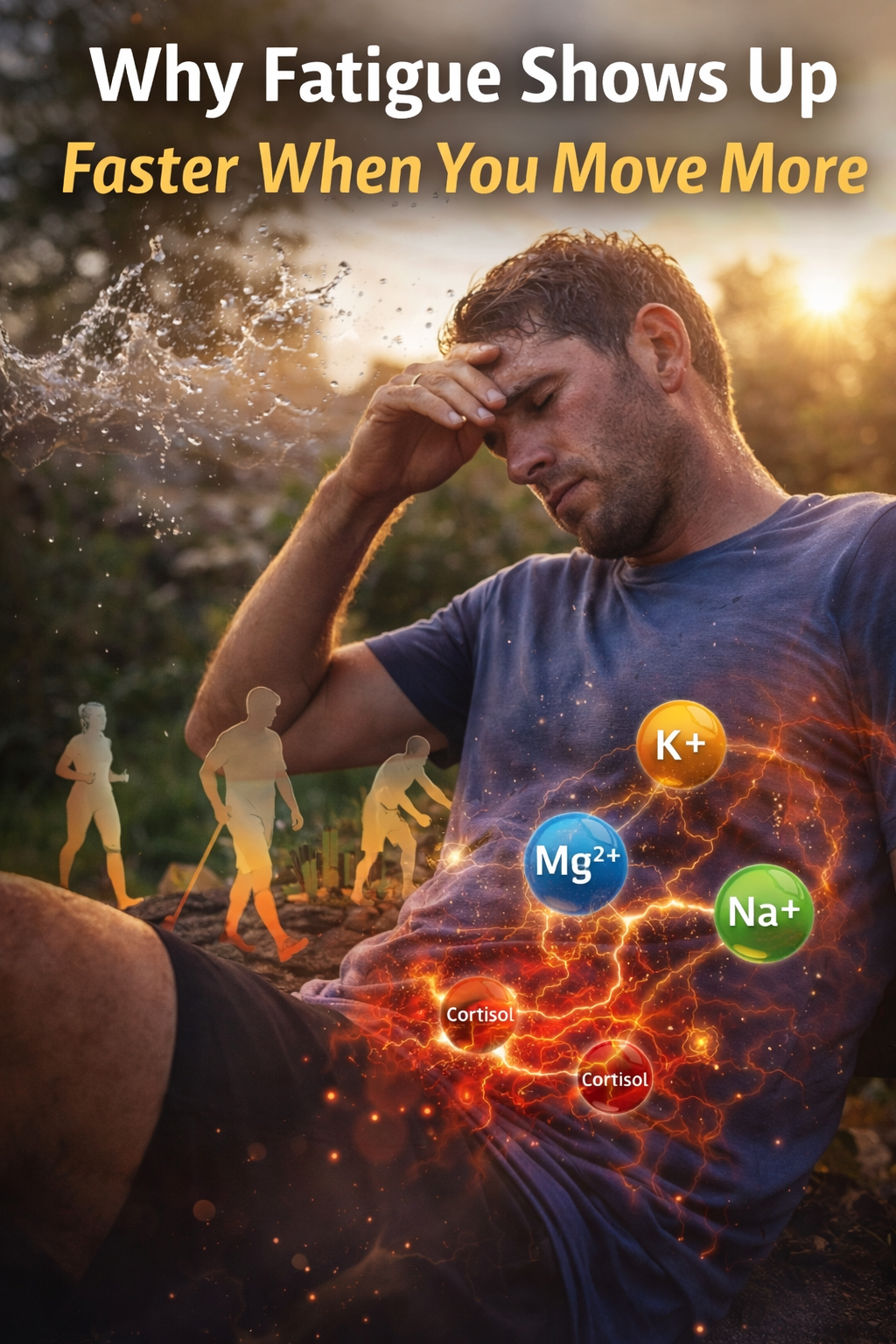
This is often why someone can say, “I’m hydrated, but I still feel weak.” Hydration isn’t just about water. It’s about electrolyte balance.
Water without minerals can actually dilute electrolytes further. Muscles need intracellular hydration — water inside the muscle cell — and potassium is essential for moving and holding that water where it belongs.
When potassium is low, water tends to remain outside the cells. Muscles may appear hydrated overall, but inside the cell — where energy is produced — dehydration persists.
And that’s where fatigue is born.

Muscle Cramps Are a Signal, Not a Flaw
Cramps are often brushed off as random. But they rarely are.
A muscle cramp is essentially a contraction that won’t fully release. Potassium helps regulate that release phase. When levels are insufficient, muscle fibers can remain partially contracted. The result is tightness, twitching, or sudden cramping — often at night or during activity.
This is why cramps frequently show up after workouts or wake people from sleep. During the day, your muscles are constantly contracting and relaxing. If mineral balance is compromised, the relaxation phase becomes inefficient. At night, when the body shifts into recovery mode, those imbalances can surface more noticeably.
It’s not a flaw in your muscles. It’s feedback.
Your body is signaling that electrical balance needs attention.
Energy Is Created Inside the Cell
There’s another layer to muscle fatigue that often goes unrecognized: cellular energy production.
Energy in the body is generated in the form of ATP — adenosine triphosphate. ATP is produced inside the cell, primarily within structures called mitochondria. For this process to function efficiently, nutrients must move into the cell and waste products must move out.
Potassium supports both.
It helps maintain the electrical gradient across cell membranes, which allows nutrients like glucose to enter and metabolic waste to exit. Without adequate potassium, this transport system becomes less efficient. Cells struggle to produce energy at the rate your muscles demand.
The result feels like weakness.
But it isn’t necessarily a lack of muscle mass or determination. It’s a cellular energy bottleneck.
Your muscles are ready to work. They just don’t have the internal conditions to sustain performance.
Why Stimulants Don’t Solve the Problem
When fatigue shows up, many people turn to caffeine or pre-workout supplements. These stimulate the nervous system. They can increase perceived energy. They may even improve short-term performance.
But stimulation is not the same as support.
Caffeine can make the signal louder. It doesn’t fix the signal pathway.
Potassium works differently. It restores balance at the cellular level. It supports natural electrical signaling. It enhances efficiency rather than overriding fatigue.
This is why someone can feel energized from caffeine yet still cramp or hit a wall mid-workout. The nervous system may be activated, but the muscle cells remain under-supported.
Endurance is built on efficiency, not stimulation.

Recovery Is an Active Process
There’s a common belief that recovery simply means rest. But biologically, recovery is active repair. After exercise, muscles must relax fully, restore fluid balance, clear metabolic byproducts, and rebuild tissue.
Potassium plays a role in each of these steps.
It helps muscles return to a relaxed state. It supports fluid movement back into cells. It assists with waste removal through proper electrical gradients.
Without sufficient minerals, recovery slows. Soreness lingers. Tightness persists. The next workout feels harder before it even begins.
Many people attribute this to aging or poor conditioning. But mineral depletion often plays a hidden role. The body can repair efficiently only when its foundational elements are present.
Supporting mineral intake after movement is just as important as supporting it before.
The Hydration Misconception
Hydration has become synonymous with drinking water. And while water is essential, it’s only part of the equation.
Muscle cells need electrolytes to maintain osmotic balance. Potassium is the primary intracellular electrolyte — meaning it’s concentrated inside cells. Sodium, on the other hand, is concentrated outside cells. Together, they regulate fluid distribution.
If potassium intake is inadequate, the body struggles to maintain this balance. Water may pool outside cells rather than nourishing them internally. Muscles can feel fatigued even when overall fluid intake is high.
True hydration is mineral-supported hydration.
That distinction matters.
Why Potassium Works Best with Magnesium
Potassium initiates muscle contraction and helps reset electrical charge. Magnesium supports muscle relaxation and stabilizes the nervous system. These two minerals work in tandem.
When potassium is sufficient but magnesium is low, relaxation can still be impaired. When magnesium is adequate but potassium is insufficient, signal transmission remains weak.
Together, they create smoother contraction-relaxation cycles. Cramping decreases. Endurance improves. Recovery becomes more efficient.
Enzymes add another layer of support by assisting nutrient breakdown and absorption. Efficient digestion ensures that minerals and amino acids are available for muscle repair. When digestion is compromised, even a nutrient-rich diet may not translate into cellular nourishment.
Muscle performance is not isolated. It reflects whole-body coordination.
The Gradual Nature of Depletion
One reason potassium deficiency often goes unnoticed is that it doesn’t always present dramatically. Severe deficiency is rare in otherwise healthy individuals, but mild depletion is common — especially when diet is inconsistent or stress is elevated.
Processed foods tend to be lower in potassium and higher in sodium. High sodium intake without adequate potassium skews electrolyte balance further. Add physical activity, sweating, or chronic stress, and the margin narrows.
Symptoms may be subtle at first. Slight fatigue. Minor cramping. Heavier legs. Reduced endurance.
Over time, these signals compound.
The body adapts — until it can’t.
Movement Should Feel Sustainable
There’s a difference between productive fatigue and mineral-driven fatigue.
Productive fatigue feels earned. You worked hard, and your muscles are pleasantly tired. After rest and nourishment, they rebound stronger.
Mineral-driven fatigue feels frustrating. It shows up quickly. It lingers longer than expected. It doesn’t match your effort.
Understanding this distinction changes how you approach performance. Instead of pushing harder or adding more stimulation, you consider whether the foundation is supported.
Are your muscles hydrated at the cellular level?
Are electrical signals firing efficiently?
Is recovery being nourished, not just delayed?
These questions shift the focus from force to function.
.
Supporting Smarter, Not Harder
Strength training builds muscle fibers. Cardiovascular activity improves endurance. But neither can override mineral imbalance.
Potassium supports movement at its most fundamental level. It doesn’t create muscle mass. It enables muscle function. It ensures that contraction and relaxation occur smoothly. It allows energy production to keep pace with demand.
When potassium levels are adequate, movement feels smoother. Endurance increases naturally. Cramping decreases. Recovery improves.
This isn’t about chasing extreme performance. It’s about restoring baseline efficiency.
When the body’s electrical system is balanced, effort translates into output more effectively.
And that changes how movement feels.
.
Final Thoughts
Muscle fatigue isn’t always about strength.
Often, it’s about what your muscles are missing.
We tend to think in terms of discipline, motivation, or protein intake. But beneath those layers lies something more fundamental — mineral balance. Potassium plays a central role in electrical signaling, hydration, and cellular energy production. Without it, muscles struggle quietly.
If movement feels harder than it should… if cramps appear despite hydration… if endurance fades faster than expected… the issue may not be weakness.
It may be imbalance.
Supporting mineral intake doesn’t replace training. It enhances it. It ensures that your effort is met with the internal resources your body needs to perform and recover efficiently.
Instead of pushing harder, support smarter.
Because muscles don’t just need strength.
They need electricity.



0 Comments